
Chapter One—The Diagnosis
You suspect something is not quite right in the fall. The fungus is worst on your right thumb, which cracks and bleeds, sheds its skin, cracks again. You try every over-the-counter remedy, soak your fingers in Listerine and eucalyptus oil. You’re self-conscious. You keep a box of Band-Aids and gloves in your right-hand desk drawer. The nurse gives them to all of you every year in August after you check off having viewed the blood-borne pathogens video. So, you cover the tips of your fingers. Your regular GP says the nastiness on your digits will go away eventually, he doesn’t seem too concerned. He’s much more concerned months later when he feels the lump in your left breast that grows 2 ½ cm from July to December, the lump your body is fighting so hard it can’t handle any other invader, even the fungus. Hindsight 20/20. Except it’s a student who first shows the concern the doctor does not. He’s the quiet one, a football player in your AP lit class who sits closest to the Promethean Board and is never without his maroon and gold letter jacket. One day, when you pass back a paper with the nasty hand, he looks at your bloody Band-Aided thumb and then up at you. Not grossed out. Worried.
“Mrs. Toner,” he asks, just above a whisper. Are you okay?”
“Yes,” you answer. “I’m fine.”
********
Your husband discovers the lump on the first night of winter break, but you still don’t have a definitive cancer diagnosis when you return to the classroom on January 3, 2017. Your room is in the back corner of the building, a closet of a space with eight tables, not nearly big enough for classes of twenty-eight juniors and seniors. You’ve set up an office in a passageway between your room and your work wife’s. You don’t see each other over break, and you won’t have told her about the biopsy, the canceled trip to your parents’ house that required your telling them and your two daughters. About the lump, about the waiting, about the not worrying until you know there’s something to worry about. That’s why you haven’t told anyone in the building. You sit in your office during planning, staring at your phone. The papers pile up. You’ll get to them later. When everything’s all right. When you can sleep again. You don’t get a call by the end of the day on the 4th, and you say goodbye to the parent who works the front as you’re walking out. She is a well-meaning busybody, perfectly highlighted hair, knock-off Coach purse in her desk drawer.
“You look tired,” she chirps as you pass by.
“I am,” you shoot back. She sits back, shocked, disapproving. It’s not like you to be so rude.
It’s the anniversary of you and your husband’s first date. It is also the night the doctor calls with the news, and that same husband holds you. You call your parents. Your youngest sister who lives in your hometown happens to be stopping by to visit them, so you kill two birds with one stone. You won’t remember a single thing any of them say, but your baby sister will apologize later, while you’re in the middle of chemo, for saying the wrong thing that night. You still, seven years later, cannot recall what she said that was supposed to upset you. You learn that the perfect thing to say does not exist.
Before you make that call, you and your husband sit down with your two daughters and tell them. You remember what you say to them.
“I love this life, and I promise I will fight like hell to keep it.”
The oldest is a freshman in college, the youngest a freshman in high school. You’ll be back in high school in the morning. But first, you must call some co-workers. You make calls to four of them. You call your work wife first after you’ve poured yourself a scotch. During treatment, you’ll develop a sweet tooth and switch to bourbon. You just don’t want to tell your closest friends while they’re in the building. They have students to face. You too have kids you need to talk to in the morning.
Chapter Two—The Reveal
First period is journalism, a class of twelve. Your cell phone rings right after announcements, and you pull it out of your pocket.
“Sorry guys,” you say. “You know I never do this, but shit’s gotten real.”
They stare at you, silent, as you step out into the hall.
“Dr. Harding wants to know if you have a preferred breast surgeon.”
“Like I keep one in my rolodex.”
“Okay, this is one he prefers. She can’t see you until the end of the month.”
“I need to see someone this week. You remind her that the tumor went from nothing to 2 ½ centimeters, palpable, in a matter of months. Then, you walk back into class with an appointment with another surgeon for that afternoon. You’re used to doing things quickly, lunch in twenty minutes, bathroom breaks between the bells.
The students are sitting, staring. Then your work wife bursts through the door connecting your classroom to hers. Bursting is her thing. It’s one of the things you love about her, but she’s about to out your diagnosis to a roomful of kids. She is holding a green folder in her hand with a stack of blue paper inside.
“Blue and green are the colors of good health,” she has written on the first page, with a list of ten people she knows who have survived cancer.
“You’re going to beat this,” she says. “Just keep adding names as you think of people until you can add yours.”
The kids sit so still you can hear the heating unit kick on and off. You’re grateful the smallest class gets the first reveal. You begin the speech you’ll give four more times in the next two days.
“You might have noticed I’m on the phone a lot, distracted. Now I’m going to tell you why. I’m sick. Breast cancer. I’ve actually named the tumor because that’s what writers do. I’ve named her Cassandra, after a character from Greek mythology. And I’m gonna beat that concubine bitch.”
You curse twice in class that day. You haven’t often done that in twenty years of teaching. The kids turn to look at each other when you’re done and clap. Then you continue the lesson.
The second morning after you find out, you find the French teacher you’ve recently gotten closer to. At first, she terrified you. She’s loud, takes no shit, has no patience with most people in the building. But she beat ovarian cancer two years ago, and you covered some of her classes during her chemo and again when she had a mastectomy after a BRACA diagnosis. There was a morning after her hair began to grow back when you worked up the nerve to say something. Her hair had been gorgeous–long, thick, black curls. When it returned, it came back completely white. That morning after she finally took off the hat, and it framed her face so perfectly, you approached her in the workroom.
“I just want you to know,” you said. “I think your hair is sexy as hell.”
Her eyes welled up, and from that moment on, you were friends.
You find her as soon as you can that second morning after your own diagnosis and tell her in the middle of the hallway right in front of the attendance office. She grabs you.
“Jesus Christ! she says, wrapping you in a hug. “There ISN’T a God. So many assholes in this building who deserve this instead of you.” Then she drags you into her classroom, shuts the door, pulls up her sweater, and shows you her breast reconstruction.
“I have the BEST surgeon. He gives you nipples. See? Let me give you his number.”
********
At the end of day two, after the final bell, a girl from your fifth period AP class walks in with a gift bag. She’s another quiet one, misses school a good deal. Her hair is long, shaggy, often in front of her face, and she spends a lot of time, when you’re not prodding her, with that shaggy head down, hair splayed on her desk. Sometimes it’s pulled back, her eyes are bright with enough sleep, and she contributes. You’ve helped her along. She’s smart, obviously going through things she doesn’t wish to share, and when she turns work in, it’s high quality. College will be a challenge for her, you’ve told her so, but, for now, you let her sit at the front table when she makes it to the first period of the day and hold her hand a little.
She hands you the gift bag.
“I wanted to give this to you. My aunt has been fighting ovarian cancer for eight years. It’s been rough. I’m not gonna lie. It’s gonna hurt. But I know you’ll need these things.”
She walks out before you can look inside, where you’ll find a tube of lip balm, pieces of ginger candy, and a scarf–-blue, gray, black, a modernist half paisley pattern. You’ve already decided to do scarves instead of wigs, and this will always be your go to. You sit at her table, and, for the first time since the doctor called , break down in sobs.
Chapter Three—Teaching During Treatment
For almost a quarter of a century, you’ve thrived on schedules and those schedules staying consistent. The “Toner Timer” as one principal put it, set for five minutes for this class activity, twenty minutes for the next. You hold your ADD at bay between these concrete walls. Students file in, file out, the same time every day after you’ve parked in the same spot right outside of the art wing, swiped your ID to enter the door, checked out the wall murals painted and repainted every year during homecoming week. One year a Mardi Gras theme, purple and yellow, masks, beads. Another year, board games, Clue, Candyland with the names of seniors already gone, painted in cursive in the right-hand corner under the gumdrop forest. You can make your way to your classroom with your eyes closed. Same time, same sounds of laughter, footsteps, rustling paper, the smell of sausages and eggs as you pass by the cafeteria.
So, it helps that your oncologist gives you a lesson plan for chemo. She’s the Stanford/Georgetown grad your general surgeon insisted upon. She scribbles everything on both sides of a piece of printer paper:
Chemo, surgery, radiation.
She circles chemo and explains the order because she recognizes your discomfort with living any extra time with the concubine bitch inside you. This plan makes the most sense. Shrink her down first, eviscerate, then bring in the knife and excavate her ass.
She draws a number line below that with the dense doses marked.
AC (Adriamycin Cytoxan) week one.
More AC week three. She jots down that your hair will be gone by then.
More AC week five.
Last AC week seven.
First week nine.
Second Taxol week 11.
Third Taxol week 13.
Fourth Taxol week 15/16.
8x2 weeks=16 weeks=4 months she writes at the bottom. You remind her that you’re an English teacher, allergic to equations, and she laughs. You use the same strategy with every medical professional in the following months. Make them laugh if at all possible. As she laughs, your gaze rests on the small box of tissues on the table where she, your husband, and you sit. You wonder how many times a day it gets used. How much bad news she must deliver every Monday through Friday. And they say teaching is hard. You don’t need the tissues today. Lymph nodes are clear. She’s put a big X through the Carboplatin trial after surgery as a result. Plans adjusted,
She continues to write on the flip side of the page:
Genetic Testing,
BrCa1 and BrCa2 if positive.
These tests, along with twenty-five others, come back negative, and you call your husband from the copy room giving him the news. “Lumpectomy, baby! The girls are stayin’!”
Side Effects:
* 1–Fatigue–four days (common)
2–hair loss
3–nausea
4–mouth sores
5–low white blood cells–Neulasta (shot)
3–constipation/diarrhea
4–fingernail loss
8–heart
To Do:
Chemo class- Mon
Mediport
Echo
Labs
This to-do list has boxes to the left that you check which gives you an idea. You’ll keep your own “Cancer to-do List” through chemo, surgery, radiation, at the beginning of the next school year, and the follow-ups with her and your surgeon and radiation oncologist that run through January of 2018. That’s when you’ll delete that list and maintain the others of a teacher—novel units, due dates of essays, and the date of graduation 2017, the one you pray like hell you will be attending.
********
You begin chemo on the last Thursday in January. These are high schoolers, not small children who rub their snot all over you. So, you decide to continue working through it all. You arrange for a sub to take your classes every other Thursday and Friday and fit the bloodwork in after the school day. You’d rather work–rather not use up any leave you don’t have to. Your husband takes your youngest to school and gets a subscription to Hello Fresh, learns to cook. You come home and collapse on the couch in front of the TV and sleep for several hours every day. Mondays after treatments prove the worst. After the steroids have worn off and you’re on that day four of fatigue that the doc wrote down in the original plans.
On January 26, 2017 for the first time, you settle into one of four chairs in the infusion center. The choir teacher, a friend, gives you a box set of jazz CDs to load into your digital library. Another colleague who lost her mother to breast cancer at fourteen makes you a homemade blanket with pink and white ties all around. It’s covered with pale pink ribbons, very fuzzy, warm. You tuck yourself in. Your husband sits in the chair next to you and hands you a copy of The New Yorker after the nurse hooks you up. He asks if you want any of those baby saltines another coworker gave you.
“Just think, you could be starting first period now,” he reminds you. You just look at him. Instead of the pledge of allegiance and spewing from the intercom, saline flows through your port, which feels and tastes like you’re brushing the inside of your veins with spearmint Crest. There is a text from your youngest sister. It’s a movie. She and her husband have recorded themselves playing a song to let you know they’re thinking of you. She says she hopes this makes you smile. Your nephew plays percussion. You never see his face, but you hear the rattle, see it, red, shaken by his tiny hand as they play for you “The City of New Orleans.” Your brother-in-law, the professional musician, keeps a steady 4/4 beat on his baby Martin with just a bit of swing. Your baby sister holds back tears. You taught her that song years ago. You close your eyes and listen.
********
Your long-term sub, a former colleague recently retired, leaves you a note on Friday afternoon. All good. Students followed instructions. You always rolled your eyes at the fact this particular teacher had her entire year’s syllabus planned out to the day in August. How she needed one hundred and twenty-five copies of the same edition of The Great Gatsby for her classes so everyone had the exact page numbers with no chance for confusion. Then you remember when the two of you shared a study hall a while back in the cafeteria. How she’d somehow be able to tell when you were having a bad day and leave a baby Snickers or an apple at your desk. You two became friends, and she agrees to take your classes every other Thursday and Friday for the next four months.
After your second treatment, she leaves a card with the latest stack of papers to grade. It’s fifteen inches square, folded posterboard. Construction paper inlaid breast cancer ribbons (you’ve been seeing a lot of these) on the front and inside. Pink bubble letters outlined in black, print and cursive. On the outside, “Get Well Soon!” Written inside, “BE Strong.” Students have written messages to you:
–Throughout our lives, we all go through many enduring hardships, as our lives are like mountains and rivers, twisted and turning.
–Many people get through cancer…you’ll be one of them.
–When I first met you, I knew you were strong willed. So, I know you will be very strong and fight breast cancer! I would like to thank you for still sticking to coming to school and still teaching us, which I know it’s your passion to teach.
–Praying for you! (Romans 8:18).
–Thank you for inspiring us and believing in us. Beat the B#$%@!”
And, right in the middle, above the word strong, you find a signature from your sub:
–You are very loved!
Chapter Four—The Difficult Student
She's a pain in your ass, but they’re always your favorites. She sits at the table closest to you, the same one with the girl who gives you the gift bag after you tell them you’re sick. The difficult student yells out loud in class that she hates Their Eyes Were Watching God. She tells you in the hall that it’s because Tea Cake beats Janie.
“Why are you triggering us like this?” she asks.
“The hell we’re broken,” she challenges you when you try to explain how they can approach character analysis. And you understand. She has a history, and she’s come a long way from junior year when counseling had to pull her out of class. Even though you love them, difficult students frighten you. You’ve lost them to suicide, gun violence, bicycle accidents when they weren’t wearing helmets. In almost twenty-five years, you’ve had to approach parents in funeral homes. Offer your condolences because that’s what you do. The difficult student is here, though. A success story, but a work in progress. In October, the same month she gets a star-shaped tattoo on the nape of her neck right under her hairline–it’s a short, straight bob, pitch black–she protests reading Michael Cunningham’s version of “The Monkey’s Paw.” She says it’s too violent. She’s seen enough violence for real.
She will be the one, when you do chemo, who skips class.
You’ve learned not to overthink your own importance to your students. Here be dragons. Your own mother (a former teacher herself) told you once that every teenager in conversation with an adult has an agenda.
You meet with this student one Monday when you’ve checked the attendance report. She skipped Friday. Again. She stands in front of you, thin arms sticking out from her black t-shirt hugging her own chest.
“You're such a good student. Why are you doing this? I really appreciate you all not taking advantage of me being out. It creates a headache for both of us when you do, you know? What’s going on?”
She continues to hug herself for a minute, silent. She’s rarely silent. That’s what you dig about her. You wait.
“I’m sorry.” She looks down at the floor. This is a kid who always meets your eyes. Unabashed. Unashamed. She adjusts her glasses.
“It's just that…when you’re not here…it’s not…okay.”
That’s when you get it. You’ve got abandonment issues of your own. She’s scared. She’d rather have you there. You're flattered, and gutted, at the same time.
“Okay,” you say. “I promise I’m here when I can be. I’d much rather not be doing this. Really. But I am. And I need your help.”
She nods and never skips again.
Chapter Five—The Creative Cure
Your cousin sends you a package with three things:
- A wooden angel ornament
- A box of pencils
- A card that tells you to make music, get outside, and write every day.
These will be the three best pieces of advice you get from anyone.
You sit down at the antique mahogany Vose and Sons baby grand you inherited from a neighbor that fall and teach yourself to play the blues. You’re classically trained, never did anything by ear, and your ears have been failing you for years anyway. You took sax lessons a few years ago, and that’s when you learned the pentatonic, the mixolydian, the diatonic scales, the way jazz musicians use chords and charts to move, to stay moving. You must stay moving. You sit at the piano bench, angel hanging from the piano lamp, and wail on those keys. Everything hurts less when you’re playing. You don’t feel the tingling from the Taxol, the neuropathy singeing your fingertips. You play and play. Sometimes you sing. “Angel from Montgomery,” “Give Me One Reason,” “Freight Train,” Carole King’s “Way Over Yonder.” You listen to Bud Powell in your study, memorize every progression, marvel at his tragic genius.
Then there’s the night of the African American read-in at your school. Your guest is a poet named Venus Thrash. She delivers a mixture of spoken word and lyricism. She stands on the stage, head shaved, as bald as you are. The difference is she wears it that way on purpose, proudly, caps it off with blue jeans and a jacket of red velour. Some students read their own work; other students and faculty members like you dig into the annals of art, find prose and verse to share. The stage and audience are full. For the read-in, every year, you’ve shared music written by people of color. This year, you combine piano and poetry. You choose Duke Ellington’s “Black, Brown, and Beige.” First you introduce, then you project the lyrics.
You play and play and play with your black and blue (those seem to be your colors) cloche scarf another colleague gave you, your soft turtleneck sweater covering your mottled neck, warming it to the bottom of your chin.
The students on stage, choir members, other shy ones roped into reading a poem with steely passion, class clowns lowering their voices, looking inside before projecting, giving it all to the audience. They come up to the mic one after the other and read, sing, celebrate themselves and others. You whoop for each one, the energy in the auditorium electric. And you’re happy the chemo actually killed that fungus and the neuropathy from the Taxol doesn’t keep you from playing on this night. You swear the concubine bitch inside your body is shrinking. The singing, the celebration, these kids—they help.
Chapter Six—The Aftermath—a snow day
You take mass transit to school seven years after your original diagnosis, the year before you retire. Or maybe the year you retire. Life has taught you, classically trained, how to improv. The walk from the Metro station is a pain-in-the-ass, not so much because of the freezing temperatures two weeks before Christmas Break, or the two and a half miles you walk in the wrong boots with heels that are too high. In the suburbs, finding sidewalks frustrates you. They begin, end, with no design. You press the crossing buttons, wait five minutes for each one, and traffic zooms by. The neighborhood where you teach is far from scenic. Aluminum-sided houses elbowing each other from subdivision to subdivision. Maybe they’re beautiful inside. You wait, cross, zigzag forty minutes, until you walk through the halls you’ve known since you could look across the street and see nothing but fields. They just keep building.
Your students too, they keep building their own lives. The student who asked if you were okay graduated from Johns Hopkins. He became a journalist. He wrote for Rolling Stone. then did marketing for the MLB. He became a fellow in the league’s Content Diversity Initiative. You follow him on Facebook, love the pieces he posts, tell him how proud you continue to be, year after year.
“Thank you, Mrs. Toner,” he comments back with a heart.
The student who skipped your class during chemo, graduated from an excellent state university Phi Beta Kappa and summa cum laude with a degree in sociology and criminology. She came back her sophomore year to return the copy of Underground Railroad you leant her right before she left for college. You follow her on Facebook and see her smiling, in love, living. She’s still here. So are you. You run into Venus Thrash, the poet, several more times before she dies suddenly of heart disease four years after the night of that read-in. You think about how much stronger, sturdier she seemed than you at that moment, and you know survivor’s guilt, again.
As you sit at your desk during first period planning, you remember another walk you took the day before your birthday during treatment. It snowed mid-March, you had an unexpected day off before an infusion, and you and your husband decided to venture out in your own neighborhood, a more scenic planned community, in your humble opinion. You bundled up, stepped outside, and didn’t even make it around the block, much less two miles. So, you went home to write a poem. Then, you remember another poem you wrote before this all began. At the time, you wrote it for a friend going through a traumatic life event and revised it several times over several years until it finally found a home. Today, as that concubine bitch Cassandra is nothing but a crater of scar, and you sit at the precipice of something new, you consider that you may have been writing to your future self all along.
Airing Out: Consolation for the Artist
for Andrew Wyeth
We start in the off-white light, skin
clear, then cracked, by the sneaky tease of seasons
that peel each painted layer year by year.
Our still lives are a rain worn, half-open
window. That glass hand-blown, we wipe the dew
rebrush, recreate the view, so we see
through the darkened space. The tables, chairs
are barely there, dust in the corners, mice
in the rafters. The sky soaks the wood
to watercolor. It’s an hourglass
turned on its side. When the sand,
the dirt, our eyes run to the bottom,
it’s not an end at all. The other side
of black is green, a spot of robin waiting.
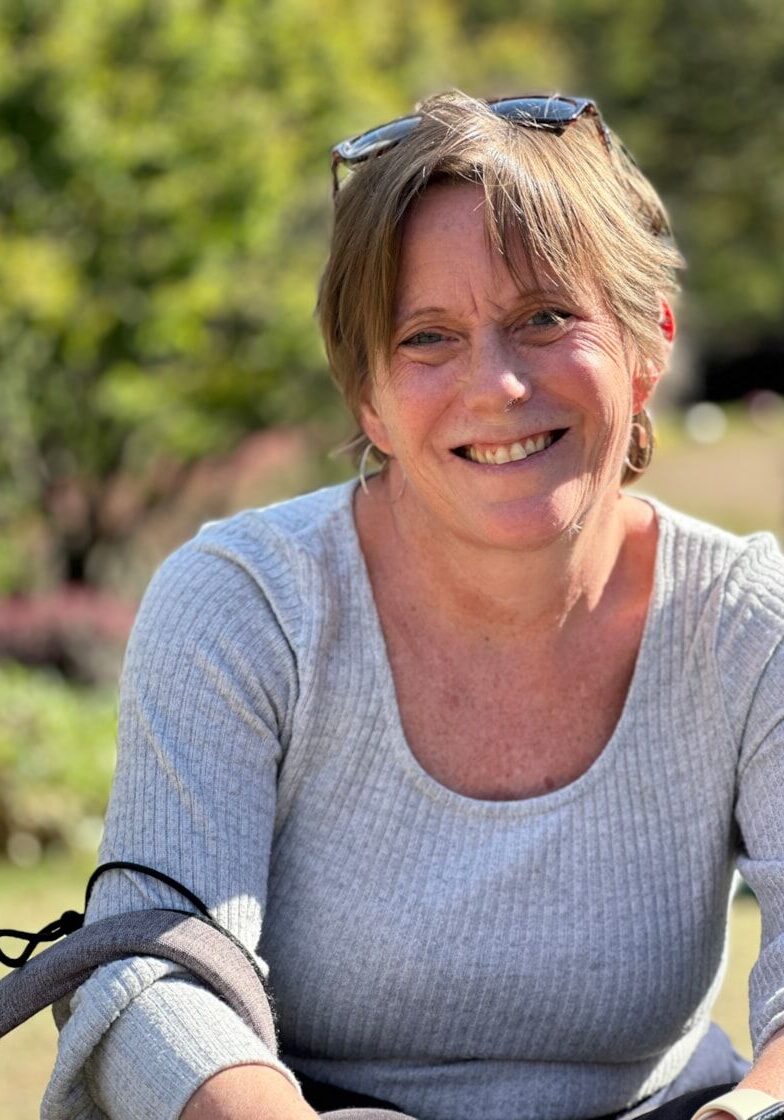
Sally Toner (she/her) is a writer and retired high school English teacher who has lived in the Washington, D.C. area for over 25 years. She is a Pushcart nominee whose poetry, fiction, and non-fiction have appeared in Northern Virginia Magazine, Gargoyle Magazine, Fractured Lit, Watershed Review, and other publications. Her first chapbook, Anansi and Friends, from Finishing Line Press, is a mixed genre work focusing on diagnosis, treatment, and recovery from breast cancer. She recently completed an MFA in narrative nonfiction at the University of Georgia. An empty nester with two grown daughters, she lives in Reston, Virginia with her husband. You can find her at sallytoner.com, @salliemander70 on Instagram, and on X at @SallyToner.