When we moved into our first home eight years ago, the new neighbor walked over to us and stood behind a shrub. He did not say hello or welcome to the neighborhood but make sure you cut down the bamboo—in a voice that suggested that we, like the bamboo, were invasive species. He was the sort of man who left notes on the cars of our guests telling them they couldn’t park in the alleyway; the sort of man who shut our garage door when we accidentally left it open on our way to work, a not-so-subtle message, we assumed, about the unseemliness of our clutter; the sort of man who mowed the small strip of grass between our houses in a passive aggressive commentary on our unkempt lawn.
My entire relationship with the neighbor consisted of walking past each other up and down a narrow alleyway at least three times a week without acknowledging each other’s existence, and that was just fine with me.
Over time, I found additional reasons to resent him. He was a real estate attorney and lived only twenty feet away in a Tudor-style mansion, probably twice the size of our home. Every time I looked at my scraggly weed patch for a lawn just on the other side of his manicured gardens, a knot tightened in my chest. Our house was a yellow two-story cape cod with badly chipped paint and a huge horizontal gash along the side of the garage, because the previous owner had accidentally driven his car into the garage wall and patched it up himself. The neighbor’s house had a fish pond and two equally lovely patios like gray-blue islands that I would gaze at in admiration. Our cozy home grew dilapidated in the shade of his storybook mansion.
When lockdown happened in March, I observed as the neighbor’s wife found solace in tending to her gardens, while my own garden grew more ragged by comparison. Most days I slumped in a lawn chair watching our bored six-year-old son kick up divots of dirt and trample the few remaining flowers with his soccer ball. I pored over the news on my iPhone, as the devastating virus trampled Asia and Europe. Corpses were piled high in Italian churches; refrigerated trucks became substitute morgues; cruise ships with sick passengers were trapped indefinitely at sea.
Sometimes I heard the neighbor shouting at a family of deer that appeared on their property. I watched the deer traipse through their gardens, nibbling the Hostas and Hydrangea, and I felt a delicious thrill. I recognized that the deer were ruining plants the neighbor’s wife had worked hard to cultivate but I resented her efforts to make things beautiful when the rest of the world had become so ugly.
********
At the end of May 2020, after ten weeks of lockdown, we had seen no one up close, except for the mailman and a friend who came to drop off a knitted blanket, which she placed around my shoulders like a shroud. Lockdown had felt so indistinguishable from grief that I had become accustomed to its isolation and silence, as one becomes accustomed to the sound of white noise or to the low-pitched hum of an airplane cabin.
Occasionally, a siren would pierce the thicket of silence that enveloped the neighborhood and my body would seize up, as I pictured somebody whisked away to a hospital they would never return from.
On the day of my mother’s funeral there were only two of us in the dining room, my husband and I, bending our heads toward my laptop. The light streamed in from the windows, and I was overcome by sudden nausea; I braced myself for the impact of so many faces populating a screen, pouring their pity at me. A funeral, even a virtual one, made the whole long nightmare feel real.
For weeks, I had avoided planning a funeral, though my best friend kept raising the question. “I think it could be good for you,” she suggested. “It might bring you some peace.” But I didn’t know what peace meant when I was still entrenched in a nightmare, my whole life like lacerated flesh, my mother gone after two weeks of illness. So, I evaded the question and answered a different one: “How could there be a funeral when it was still so unsafe to be together?” “How could there be a funeral without a graveside burial?” I’d been to the burials of my two grandparents and had shoveled dirt onto their coffins and placed stones on their freshly dug graves. But my mother was already buried 140 miles away in Woodridge, NY, a town I had never been to, in an Orthodox Jewish cemetery, which was the only place that would take her. When you die from a novel virus at the beginning of a pandemic, your options for burial are limited.
I remember so little of the funeral, namely my own head bobbing in and out of the screen, hovering on the fringes of the Zoom square, so that my husband was forced to be the face of our grief. I remember my friend’s mother abandoning her square halfway through the ceremony, leaving an empty white shower chair at the center of the grid, with a view of a pink-tiled bathroom. I was sure that if I looked away from the shower chair and pink-tiled bathroom I would meet the gaze of my father or a close friend and start crying and never stop. My husband’s friend, a professional actress with an ethereal voice, sang “Send in the Clowns,” my mother’s favorite song. When I was a child, my mother would play the Judy Collins version on our record player while gazing into the distance, lost in some private pain.
You’d think I’d remember more of the funeral, but what I remember most was a sudden roar in the background and then turning to see the figure of our neighbor, not three yards away, mowing the lawn. He was mowing the narrow strip of grass that ran between our two houses, grass that was neither clearly ours nor his.
In fury, I leapt from my chair and pushed open the door to the yard to confront the neighbor ruining the funeral.
“It’s my mother’s funeral!” I shouted over the wailing machine, which caused him to stumble backwards. He wore oversized goggles and noise-canceling headphones in red pleather and looked like he belonged on a tarmac directing airplanes for takeoff. I shouted again until he staggered toward his house, abandoning the mower in its place. As angry as I was, I was also grateful for the release. His presence sent my stiff, passive body into motion, focused my rage onto something more tangible.
********
Two weeks after my mother’s funeral, I was returning from a long walk in the wildflower preserve, when I saw the neighbor out of the corner of my eye, veering toward me, pulling a tiny Yorkie named Dram.
I had never seen the neighbor’s face so clearly before. We were roughly six feet apart, the distance intended to keep us alive, and his dimpled face looked flushed from exertion. Although he was tall, his shoulders were stooped and he wore a men’s bomber jacket just like my dad’s. For a moment, we stood in silence as I crouched down to pet Dram.
“I’m sorry about your mom,” he said. “Your husband told me what happened.”
I felt a twinge in my side as if my husband had betrayed me, told the most vulnerable secret to my sworn enemy. Even though I had shamed the neighbor at my mother’s funeral, I didn’t want him to know the details: that she died of Covid in the first week of May, that I never saw her before she died, that my dad had been so sick with Covid that I thought he would die too, a double orphaning in the same week. But he had survived and was recovering slowly at home.
“Thank you,” I said, and shuffled my feet.
The neighbor looked away and then I looked away, until he said: “My grandson died of the flu two years ago.” His voice was shaking, a different voice from the one that shouted at deer.
“My god,” I said, putting my hand to my face. “I’m so sorry.”
“It’s a terrible story,” he said, and went on to explain how his son and daughter-in-law were living in North Carolina with their three children, when the youngest, who was five, came down with the flu. “He died on Christmas day, just two days after getting sick.” I stood there in silence, my hand over my mouth, as if someone had stolen my voice. Then I said the only thing I could think to say: “I didn’t know children could die from the flu.”
I had seen his children and grandchildren before, the two grandkids playing outside, though I hadn’t known of a third. I began to slot his grandchildren into my memories, exchanging the irascible neighbor shouting at deer with the doting grandfather. I imagined the five-year-old boy throwing a ball into our yard and then retrieving it in an adorable act of trespass. I imagined him becoming friends with our six-year-old son.
I was so used to reading arguments on the internet about Covid being just like the flu—a spreading ugliness that enraged me. But I hadn’t thought about how those arguments trivialized the flu, too, an illness that could still kill a child. But here we were, two neighbors, disputing the lie. My grief had been so consuming that I failed to see it could be shared.
After we parted, I felt dumbstruck and heavy with shame. I had made assumptions that I wanted to take back. Before my mother died, she told me I was too quick to judgment, that I had judged her too harshly, and I suddenly felt the sting of her reproach.
It’s been almost five years since the funeral, and the neighbor and I wave to each other now, let our dogs sniff one another on leashes, and sometimes we chat, but only about dogs or the burdens of upstate winter snow. We never circle back to the once-spoken pain. Sometimes I scan his face in these interactions, looking for signs of emotion. But there is nothing for me to see, just the phantom of my own curiosity.
I’d like to ask him how his grief has changed over time, and if sometimes his sadness still gushes, like fresh blood from a cut, all these years later.

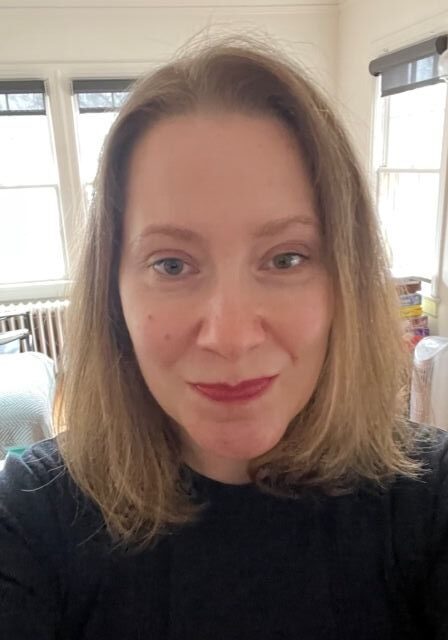
Jennifer Spitzer is an associate professor of literature at Ithaca College, where she teaches modern and contemporary literature. Her book, Secret Sharers, was published by Fordham University Press in 2023. Her personal essays have appeared in The New York Times, Huffpost, and Avidly, a channel of The Los Angeles Review of Books.